The Sacred Landscape Toward a Framework for Muslim Ecologies in South India

Each year, hundreds of thousands of pilgrims bound for the hill shrine of Sabarimala in Kerala pause, on their final approach, at a small mosque in the forest town of Erumeli. They arrive dressed as Ayyappa devotees, in black or blue, carrying the irumudikettu bundle on their heads - and yet the sanctioned route requires them first to offer prayer at the Vavar Juma Masjid, a mosque dedicated to Vavar, the Muslim warrior whom local tradition holds to have become the deity Ayyappa’s companion and the guardian of the forest crossing beyond. Muslim custodians tend the mosque; Hindu pilgrims, by long convention, are welcomed inside it before they continue toward the hills. Nobody at Erumeli is much troubled by the question of whether this is a Hindu practice that has absorbed a Muslim figure, or a Muslim shrine folded into a Hindu itinerary. The forest path does not observe that distinction, and neither, for the most part, do the people who walk it.
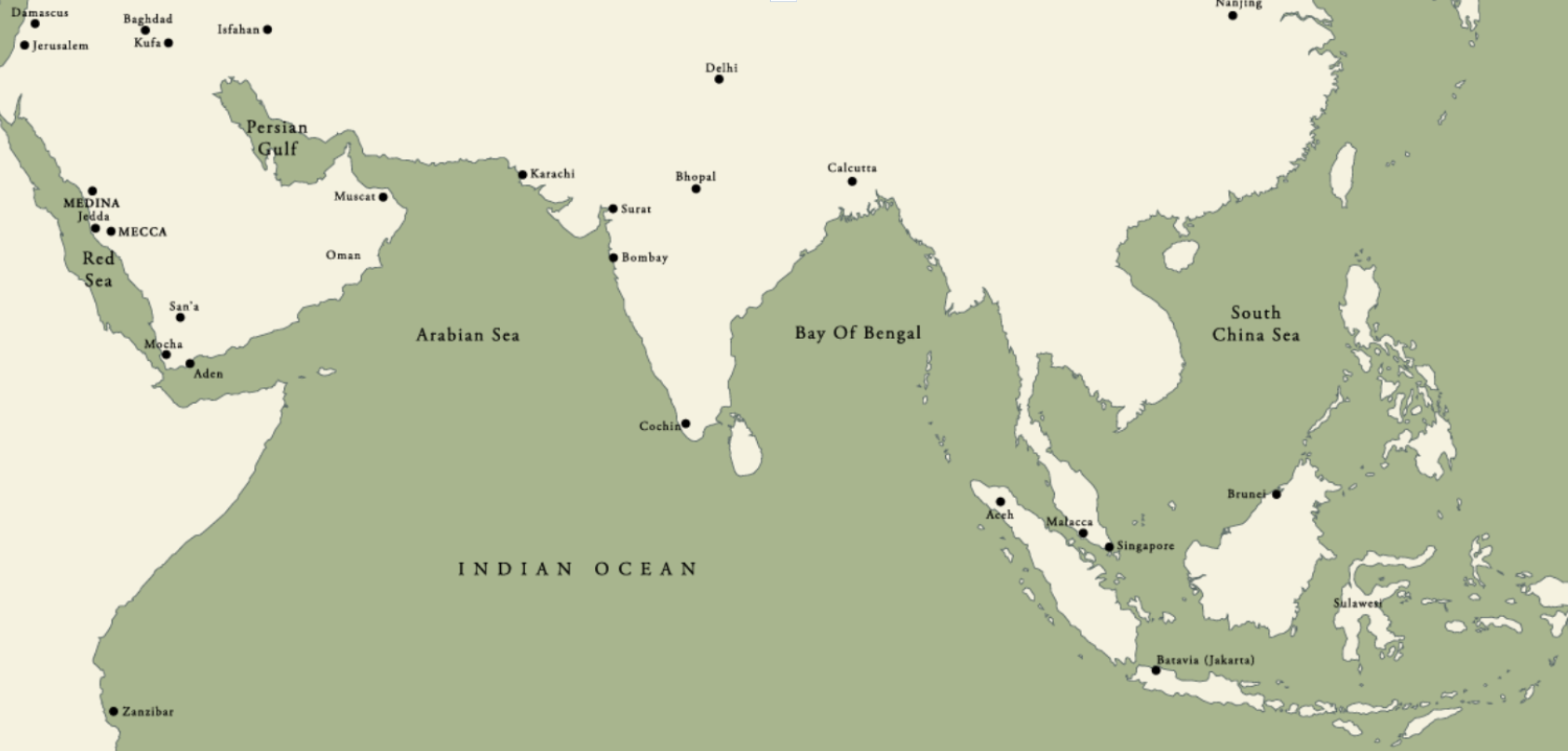
It is a fitting place to begin the inaugural issue of Limelight South, because it stages, in miniature, the question this journal has set out to ask: how did Islam become part of the landscapes it inhabited in South India, and how did those landscapes, in turn, shape the vernacular life of Islam? I have tried to open this question once before, in an essay on what I called Muslim ecologies-ecological practice and ethical reasoning in which an Islamic vocabulary does identifiable work in how land, water, and animals are managed. That essay drew mainly on the Bengal delta and the Ladakhi highlands. This one stays closer to home, in the coasts, deltas, and forest edges this issue is named for, and tries to set out, in general terms, the conceptual terrain on which the essays that follow can be read-not as a survey of a subject already settled, but as an invitation to a field that Indian scholarship has, until very recently, scarcely named.
What, Exactly, Is a Muslim Ecology?
The question is worth pausing over, because it is easy to answer badly. One bad answer treats “Muslim ecology” as a demographic fact: whatever a Muslim farmer, fisherman, or engineer happens to do with land, water, or animals, simply by virtue of the practitioner’s religious identity. This answer makes the category so capacious that it explains nothing-it would describe a Muslim engineer building a dam as readily as a Sufi custodian tending a shrine pond, collapsing the specificity of religious practice into the incidental fact of birth. A second bad answer moves the other way, treating Islam as a portable doctrine - a set of Qur’anic concepts of stewardship (khalīfah), trust (amānah), balance (mīzān), and corruption on the earth (fasād) - that simply gets “applied” to nature wherever Muslims happen to live, as though theology arrived first and landscape adjusted to it afterward.
This is closer to the mark, and a substantial global literature, from Seyyed Hossein Nasr’s writing on what he calls ecological Sufism to Richard Foltz’s country-by-country surveys of environmental thought and activism across Muslim-majority societies, has done valuable work establishing that such a scriptural and ethical vocabulary exists and travels. But a vocabulary that travels everywhere explains why nowhere in particular. It does not, by itself, tell us why the mosques of the Malabar coast slope their roofs the way Kerala’s own temples and tharavadu houses do, or why a warrior named Vavar keeps watch over a Hindu pilgrimage route through a Kerala forest.
Nobody at Erumeli is much troubled by the question of whether this is a Hindu practice that has absorbed a Muslim figure, or a Muslim shrine folded into a Hindu itinerary. The forest path does not observe that distinction, and neither, for the most part, do the people who walk it.
The more useful question, and the one this issue has been organised around, is narrower: where, specifically, has an Islamic vocabulary-a saint, a legal concept, a category of shrine sanctity, a building tradition-done identifiable work in how a particular South Indian landscape is inhabited, managed, or understood? This is a question about vernacular life rather than doctrine: about the saints, legal reasoning, devotional geography, and built forms through which Islam, arriving in South India overwhelmingly by sea and settlement rather than by conquest, took the specific shape of the coasts, deltas, and forest edges it inhabited - and in the process became one of the idioms through which those places are understood, by Muslims and non-Muslims alike. Four registers of this vernacular life recur across the region, and each opens onto one of the themes this issue has invited: shared sacred geography, maritime and coastal life, agrarian law and land, and built form.

What unites Erumeli, Nagore, and Kodungallur is not a shared theology but a shared logic of place: in each case an Islamic sacred figure or structure has become physically and ritually inseparable from a landscape that no single religious community owns.
Shrines, Saints, and Shared Ground
Erumeli is not an isolated case. Along the Coromandel Coast in Tamil Nadu, the dargah of the sixteenth-century Sufi saint Nagore Shahul Hamid at Nagore draws Hindu and Muslim devotees in numbers that rival any of the region’s temple towns; its towering minarets are locally described in terms ordinarily reserved for temple gopurams, and its annual festival calendar borrows directly from the ritual grammar of Tamil temple Hinduism even as it commemorates a Muslim saint’s urs. Kerala’s coastline carries a still older instance.
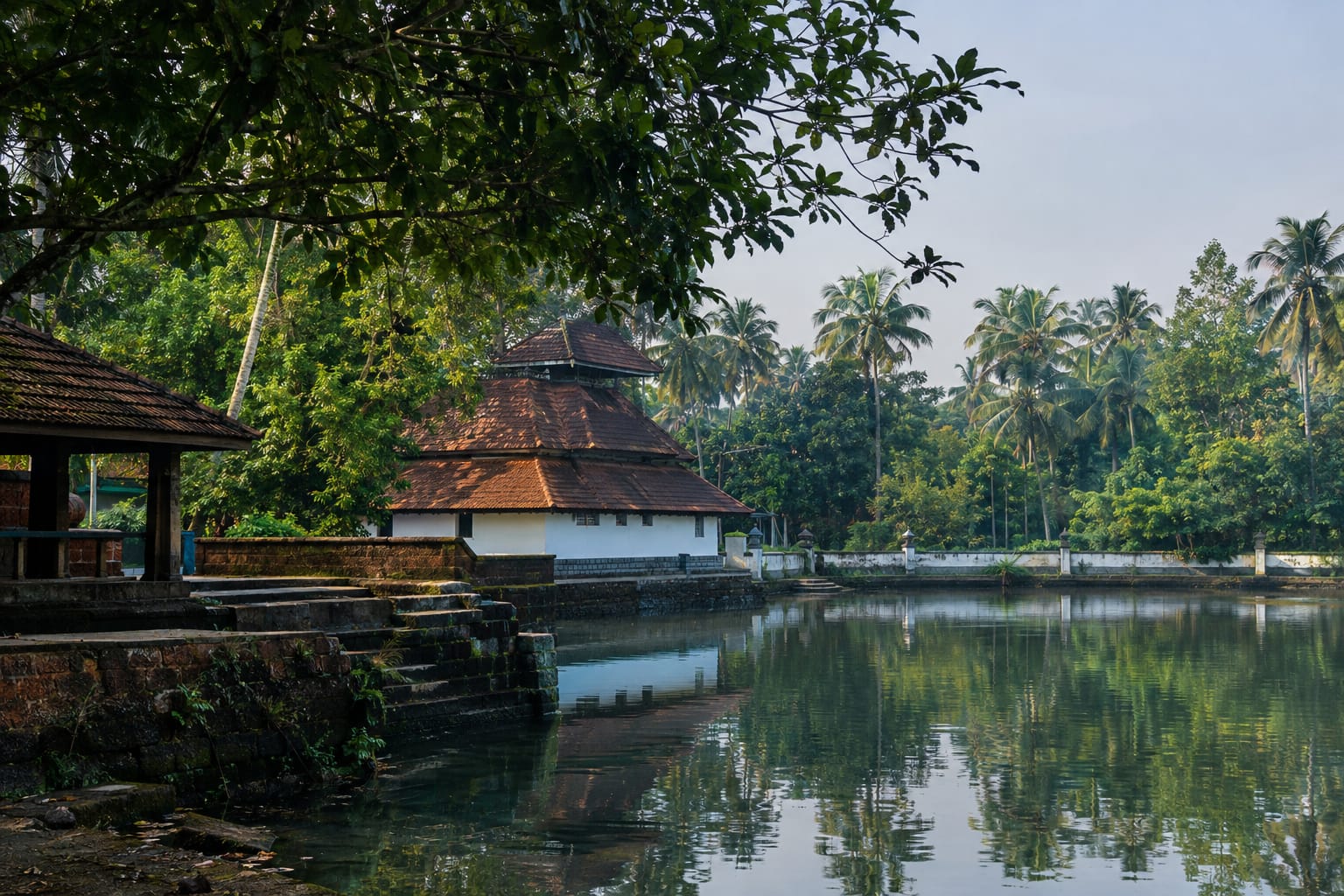
The Cheraman Juma Masjid at Kodungallur, which tradition dates to the seventh century CE, is bound up with the legend of a Chera king who is said to have witnessed the moon-splitting miracle and travelled to Arabia to meet the Prophet himself. Whatever the historical status of that founding story - and it is a legend, elaborated and transmitted over centuries rather than a documented event the mosque’s original built form is telling in its own right: a sloping tiled roof without minarets, oil lamps rather than the fixtures more familiar in the mosque architecture of the north, a structure that, before its recent reconstructions, was by most accounts difficult to distinguish at a glance from a Kerala temple or a Nair tharavadu.
What unites Erumeli, Nagore, and Kodungallur is not a shared theology but a shared logic of place: in each case an Islamic sacred figure or structure has become physically and ritually inseparable from a landscape that no single religious community owns. This is the pattern Susan Bayly traced across two centuries of South Indian religious history, in which the cults of Muslim warrior-saints took their place alongside goddess shrines and royal temples as nodes within a single, shared regional sacred landscape, drawing worship across confessional lines and often absorbing pre Islamic figures - guardian spirits, forest deities, local heroes - into a Sufi idiom of sainthood.
What unites Erumeli, Nagore, and Kodungallur is not a shared theology but a shared logic of place: in each case an Islamic sacred figure or structure has become physically and ritually inseparable from a landscape that no single religious community owns. This is the pattern Susan Bayly traced across two centuries of South Indian religious history, in which the cults of Muslim warrior-saints took their place alongside goddess shrines and royal temples as nodes within a single, shared regional sacred landscape, drawing worship across confessional lines and often absorbing pre Islamic figures - guardian spirits, forest deities, local heroes - into a Sufi idiom of sainthood.
The Sea as a First Landscape
If South Indian Islam is unusually saturated with shared sacred geography, this has something to do with how it arrived. Unlike the north, where Islam’s political presence is conventionally narrated through conquest and court, Islam reached the Malabar and Coromandel coasts principally through the older channel of Arab and Persian maritime trade, well before the Delhi Sultanate existed, carried by merchants who settled, married locally, and built mosques that faced the sea as much as they faced Mecca. The consequence is a Muslim community - the Mappilas of Kerala foremost among them-whose earliest and most enduring sacred landscape is not a conquered territory but a coastline, and whose everyday religious life remains woven into maritime livelihood in ways that persist today: Qur’anic recitation before a boat puts out, the naming of vessels with religious significance, an understanding of the sea itself as, in the words of one fisherman recorded in recent fieldwork, “a miracle of Allah and the home of my tribe.”
This maritime origin matters for the argument of this issue in a way that is easy to understate. It means that, in the specific case of South India, the presence of Islam in the landscape is not a later overlay on an already constituted geography requiring some account of accommodation or intrusion, but one of the oldest continuously inhabited religious geographies on the coast - a fact with some bearing on a present political moment in which Muslim presence near water, land, and forest is routinely narrated in the vocabulary of encroachment.
That the same coastal communities occupy a contradictory position - stigmatised by inland populations even as their labour and religious practice remain deeply place-bound - is itself part of the story this issue should be attentive to. Fishing and boat-building communities along the Malabar coast have historically been marked by pejorative terms that code them as impure or peripheral even as their knowledge of tide, wind, and season is indispensable to the coastal economy; and the material disadvantage documented across Muslim-concentration localities nationally - poorer access to safe water, sanitation, and public infrastructure than almost any other social group - has a specifically coastal and riverine inflection in these communities, whose ecological knowledge is at once indispensable and unrecognised. The ecological embeddedness and the social marginality are not separate facts but two faces of the same condition, and an account of Muslim ecologies in the region has to hold both without resolving one into the other.
Land, Law, and the Vocabulary of Right
A third register concerns not sacred geography but agrarian order. In premodern and colonial Malabar, Mappila cultivators worked land under a layered tenurial system-janmam, Kanam, and verumpattam rights held largely by Hindu landlords - that placed the community in a structurally precarious relationship to the soil it worked.  The agrarian grievances that accumulated under this system, K. N. Panikkar has shown, were inseparable from the religious idiom of protest that erupted periodically across the nineteenth century and culminated in the Malabar rebellion of 1921-an uprising conventionally read through the lens of anti-colonial or communal politics, but which was, at its base, also a conflict over land, tenancy, and the terms on which a community could remain rooted in a landscape it had worked for generations. It is a reminder that the vernacular life of Islam invoked in this issue’s title is not only a matter of shrines and cosmology; it runs equally through legal and economic relationships to land, and through the historical memory of struggles over those relationships.
Elsewhere in the Muslim world, and at the edges of South Asia proper, this legal register takes more explicit doctrinal form. In the cold desert of Kargil, Ladakh, water is distributed through collective irrigation arrangements that draw on a specific principle of fiqh-that flowing water, unlike water that has been stored, cannot be privately owned - while the cutting of juniper, ecologically critical in that fragile terrain, is restricted through community norms framed explicitly as Islamic stewardship. Kargil lies outside this issue’s South Indian remit, but it belongs in the same conceptual frame as Malabar’s tenurial history: in both cases an identifiably Islamic vocabulary of right, obligation, and restraint does concrete distributive work in how land or water is actually allocated, rather than floating free as abstract ethical commentary. A task for future contributions to this issue is to ask whether, and where, an equivalent legal-ecological vocabulary can be located within South India’s own agrarian and coastal histories-in waqf lands, in fishing rights, in the customary regulation of common resources among Muslim cultivating and pastoral communities from the Deccan to the far south.
Building With the Monsoon
The fourth register is the most visible and the least remarked upon: architecture. Mosques across the Malabar coast took on the multi tiered, steeply sloping tiled roofs characteristic of Kerala’s temple and domestic architecture-a form suited to shedding the region’s intense monsoon rainfall and built, in earlier centuries, from the timber the Western Ghats’ forested hinterland actually produced. This was not a matter of aesthetic borrowing alone; it was a building tradition arrived at, like the region’s Hindu temple architecture, through sustained negotiation with a specific climate and a specific set of available materials. That negotiation produced a form recognisably local and recognisably Islamic at once-retaining orientation toward Mecca and space for congregational prayer while abandoning, for centuries, the dome and minaret more familiar further north. Placed alongside the very different adaptations Islam made to Bengal’s monsoon delta or Kashmir’s snow load, Kerala’s sloped roof mosque tradition is further evidence against any singular “Muslim” relationship to landscape, and further evidence for the claim this issue is built around: that what is Muslim in each case is a practice that took shape differently, in dialogue with each region’s own ecology.
Faith as Vocabulary, Not Determinant
None of these amounts to a claim that Islam determines ecological outcomes in South India, or that Muslim communities have some inherent affinity with nature that other communities lack. Region, caste, livelihood, and political economy do most of the explanatory work in any given instance - often more than religious identity 10 as such. The internal stratification of South Indian Muslim society, between elite ashrāf lineages claiming Arab or Persian descent and the ajlāf majority descended from local converts and tied to hereditary occupation, has shaped access to land, capital, and education in ways that cut across any generalisation about Muslim relationships to environment, just as it has shaped the Gulf migration and remittance economies that have reorganised coastal Kerala’s built environment over the past half-century. A shrine’s sanctity does not, by itself, prevent the destruction of a mangrove forest or a polluted river; a legal doctrine about flowing water does not enforce itself without local kinship obligation and the practical fact that an entire watershed needs the system to work. Treating any of these vernacular forms as a substitute for a conservation policy, rather than as a historically specific vocabulary through which ecological relationships have been named, argued about, and handed down, would be its own kind of error.
What this vocabulary does provide stewardship, sanctity, the non-ownability of flowing water, the moral geography of a saint’s protection, the memory of tenurial struggle - is portable across the wider Muslim world, but its ecological uptake is always local: contingent on whether a particular coast needed a fishing ethic, a particular delta needed a forest cosmology, a particular watershed needed a legal principle, a particular hillside needed a roof that could shed the monsoon. This is, in fact, what most sharply distinguishes Muslim ecologies from the other subject-positions Indian environmental scholarship has, over the past half-century, learned to recognise: indigenous communities with territorial claims, women as household resource managers, Dalit communities whose ecological politics is rooted in the specific experience of caste and pollution. Each of those categories is defined by a relatively bounded relationship to a particular place or position. Muslim ecological life in South India, by contrast, is irreducibly trans-regional and syncretic: a saint venerated at Erumeli belongs simultaneously to a Sufi genealogy stretching across the Indian Ocean world and to a specific Kerala forest crossing; a mosque roof on the Malabar coast belongs simultaneously to a global Islamic architectural grammar and to the particular timber and rainfall of the Western Ghats. That doubled belonging - regional and trans-regional at once - is this issue’s most distinctive analytical opening, and its most direct rebuttal to a political discourse that treats Muslim presence in a landscape as inherently outside it.
Why This Matters Now
That political discourse is not abstract. Over the past decade, Muslim presence near land, water, and forest has been increasingly narrated through a vocabulary of encroachment and threat - “land jihad,” “flood jihad,” the routine recasting of pastoral and agrarian Muslim livelihoods as ecological transgression rather than ecological practice - a pattern of what might be called environmental othering, in which a community’s material relationship to place is systematically recoded as danger.  Kerala’s own history offers a counter-instance worth setting against this pattern: when the Gwalior Rayons factory at Mavoor poisoned the Chaliyar river through the 1970s and 1980s, Muslim organisations were among the movement’s most committed participants, framing industrial pollution in the explicitly religious vocabulary of fasad - corruption on the earth - and treating the defence of clean water and air as a matter of faith rather than a secular add-on to it. The material recovered across the registers surveyed here does not, by itself, settle the politics of the present moment. But it does establish something that politics routinely denies: that the relationship between Islam and the South Indian landscape has a longer, more intimate, and more variegated history than either side of that argument usually allows - a history in which a mosque could be built to a monsoon roofline, a forest crossing could be guarded by a Muslim saint on behalf of a Hindu pilgrimage, and a river’s pollution could be resisted as a violation of faith.
Toward This Issue
The essays this journal has invited-on sacred landscapes and shrines, water cultures, land and agriculture, mosque architecture, forests and Sufi orders, coastal and maritime communities, Islamic legal traditions, vernacular ecological thought, and shared Hindu-Muslim sacred geographies - can each be read as an extension, a correction, or a contestation of the frame proposed here. A study of a single dargah’s shrine pond, a single stretch of coastline’s fishing calendar, a single mosque’s roofline, or a single watershed’s irrigation custom will do more to test this framework than any further generalisation could. What this essay has tried to establish is only the terrain on which such studies become legible as a single field of inquiry, rather than a scattering of unrelated local curiosities: the terrain of a vernacular Islam that became, in South India as elsewhere, environmental - not because Muslims have a special relationship with nature, but because Islam, like every religious tradition that has taken root in a place for centuries, could not become local without also becoming ecological.
In the End
Pilgrims still climb the forest path out of Erumeli, past the mosque of a Muslim saint, toward a Hindu shrine on a Kerala hilltop, in numbers that make it one of the largest annual pilgrimages on earth. The path does not resolve the question of what, exactly, is Muslim about that landscape, or Hindu, or simply Keralan. It only insists that the question be asked locally, patiently, and without the expectation of a single answer. That insistence is, in the end, what this issue of Limelight South is for.
Reference
1.Kerala Tourism. “Vavarambalam in Erumeli.” Accessed September 5, 2026. https://www.keralatourism.org/destination/erumeli-vavar-mosque/213/.
2. Sharma, Mukul. “What Make Muslim Ecologies? Sacred Geographies and the Vernacular Life of Islam in India.” The India Forum, July 7, 2026. https://www.theindiaforum.in/environment/what-make-muslim-ecologies.
3. Foltz, Richard C. Environmentalism in the Muslim World. New York: Nova Science Publishers, 2005.
4. Nasr, Seyyed Hossein. Religion and the Order of Nature. New York: Oxford University Press, 1996.
5. Panikkar, K. N. Against Lord and State: Religion and Peasant Uprisings in Malabar, 1836–1921. Delhi: Oxford University Press, 1989.
6. Peters, Madhavi, and Zahid Hussain Khan. “Incorporating Islamic Environmentalism in Approaches to Conservation in the Trans-Himalaya.” Grassroots Journal of Natural Resources 7, no. 1 (2024).
7. Osella, Filippo, and Caroline Osella. Social Mobility in Kerala: Modernity and Identity in Conflict. London: Pluto Press, 2000.
8. Bayly, Susan. Saints, Goddesses and Kings: Muslims and Christians in South Indian Society, 1700–1900. Cambridge: Cambridge University Press, 1989.
9. Mathias, John. Uncommon Cause: Living for Environmental Justice in Kerala. Oakland: University of California Press, 2024.
10.Sharma, Mukul. “Muslims and Indian Environmental Politics.” The India Forum.
11. Nagore Dargah Shariff. “History.” Accessed August 26, 2026.
12. Cheraman Juma Masjid. “History of Cheraman Mosque.” Accessed August 26, 2026. https://www.cheramanjumamasjid.com/history.php.